
Parent Handbook

MISSION STATEMENT
Camino Grove is committed to being a caring collaborative community where creativity, kindness, and confident learners and leaders are cultivated.

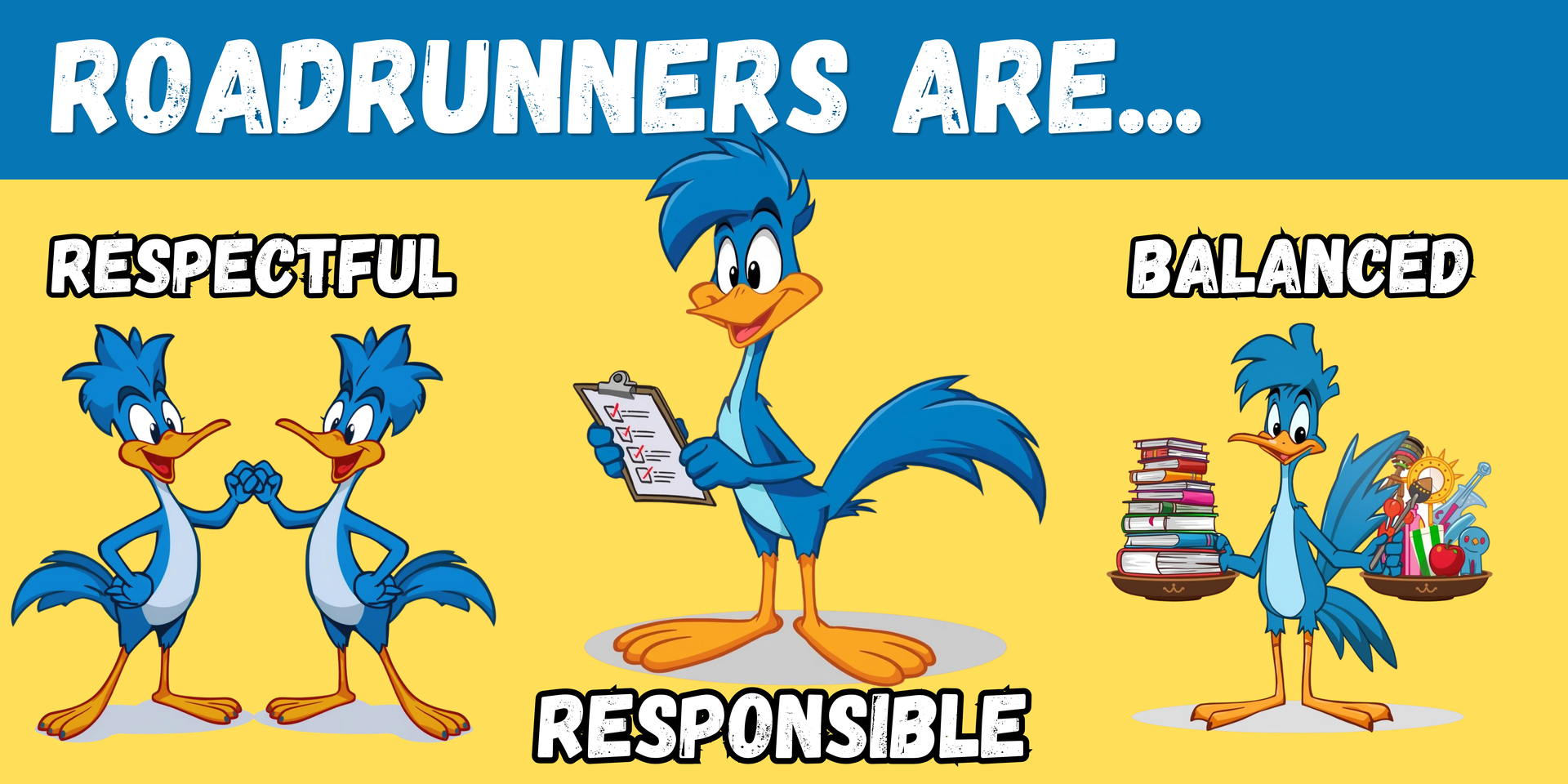
We believe cultivating leaders and learners is a shared responsibility of staff, students, and families. Leader in Me principles and restorative conversations guide how the Camino Grove Community moves forward together.
Being Responsible:
Take charge of my actions (Habit 1: Being Proactive)
Plan ahead (Habit 2: Begin with the End in Mind)
Do what’s most important! (Habit 3: Put First Things First)
Showing Respect:
Listen to others (Habit 5: Seek First to Understand and Then to be Understood)
Share and cooperate (Habit 6: Synergize)
Help everyone succeed (Habit 4: Think Win-Win)
Finding Balance and Voice:
Take care of my body, mind and heart (Habit 7: Sharpen the Saw)
Discover my talents and interests, while encouraging others to do the same (Habit 8: Find Your Voice and Inspire Others to Find Theirs).
This handbook is brought to you by the members of the School Site Council. Camino Grove School Site Council (SSC) includes a team of teachers, administrators, parents, and classified personnel. In addition, the school site's Leadership Team, which included a multi-faceted team of educators, also guides the content of the Parent Handbook.
If you have any questions you would like to be addressed by School Site Council, please click here.
SCHOOL SCHEDULE, ROUTINES, AND EXPECTATIONS
SCHOOL HOURS
Regular School Week Schedule (TK and Kindergarten)
Monday 8:25 a.m.-2:25 p.m.
Tuesday 8:25 a.m.-2:25 p.m.
Wednesday 8:25 a.m.-1:35 p.m.
Thursday 8:25 a.m.-2:25 p.m.
Friday 8:25 a.m.-2:25 p.m.
Minimum Days (TK and Kindergarten)
8:25 a.m.-12:17 p.m.
Collaboration Days (TK and Kindergarten)
8:25-11:30 a.m.
Regular School Week Schedule (Grs. 1-5)
Monday 8:25 a.m.-2:35 p.m.
Tuesday 8:25 a.m.-2:35 p.m.
Wednesday 8:25 a.m.-1:45 p.m.
Thursday 8:25 a.m.-2:35 p.m.
Friday 8:25 a.m.-2:35 p.m.
Minimum Days (Grs. 1-5)
8:25 a.m.-12:27 p.m.
Collaboration Days (Grs 1-5)
8:25-11:40 a.m.
Check the school site calendar for events, minimum days, and Collaboration days.
SAFE ROUTES TO SCHOOL
To enhance our school safety plan and provide a safe and secure student environment, we will only use the Camino Grove Avenue (front of the school) entrance for dropping off and picking up students. The Sixth Avenue gate is locked at all times. Please adhere to the following arrival and pick-up times:
Arrival Times
7:50-8:22 a.m.
Pick-Up Times
2:30-2:50 p.m. (Mondays, Tuesdays, Thursdays, Fridays)
1:35-2:00 p.m. (Wednesdays)
12:17-12:45 p.m. (Minimum Days)
11:30-11:55 a.m. (Collaboration Days)
The following information is provided to assist you in developing a home-to-school route for your child. The City of Arcadia provides crossing guards located at the following intersections:
- Sixth Avenue and Camino Grove
- Encino and Camino Grove
Students who live south of Camino Real should cross Camino Real at Sixth Avenue and proceed north to Camino Grove Avenue and the school entrance.
Students who live north of Duarte Road should cross Duarte Road at Santa Anita Avenue using the crosswalk at the signals located at First Avenue, Second Avenue, or Fifth Avenue. Students should proceed on Duarte Road to Sixth Avenue and then south to Camino Grove Avenue, where the crossing guard will assist them in crossing the street to the school.
TRAFFIC FLOW
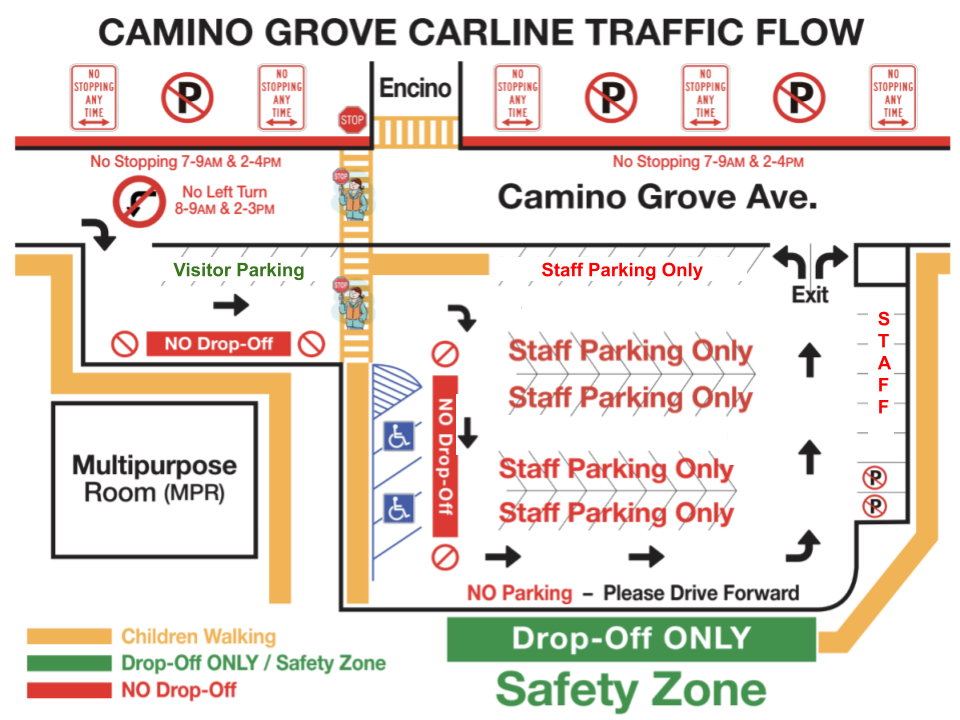
ARRIVAL
Your child should not arrive on campus before 7:50 a.m., as there is no adult supervision. Upon arrival, grades 1-5 students are to proceed to the blue tables in the covered lunch area, where supervision is provided until they are dismissed at 8:22 a.m. to go to their classrooms. TK & Kindergarten students are to proceed to the planters in the courtyard, where supervision is provided until their teacher picks them up to take them to the classroom. SELPA students should arrive at the main gate, east of the front office. Classroom teachers and instructional assistants will await your student’s arrival.
-
-
- Highly recommended to take a right-hand turn from 6th Ave. and Camino Grove Ave. to enter the parking lot during arrival and dismissal. Left-hand turns into the parking lot are not permitted.
- Slowly drive your car as far forward as possible before unloading students in front of the kindergarten and school office.
- NEVER park in the no parking zones.
-
 Also access the Carline Guidelines here!
- Slowly drive your car as far forward as possible before loading students.
- There is no waiting or parking in loading areas (these also serve as fire lane
- If your child is not waiting in the loading areas as you pull up, you may not wait. Please proceed to an empty parking space, walk to the loading area, and accompany your child to the car using the appropriate crosswalks. This will help the loading process and ease the congestion on Camino Grove Avenue.
- Parents walking can meet their child at the blue tables in the lunch pavilion by entering through the gate on the west side of the MPR. When leaving the school, please walk along the sidewalks or cross at the appropriate crosswalk in the parking lot. For the safety of everyone, do not cross between vehicles.
- Students must be picked up immediately after school, no later than 2:50 p.m., 2:00 p.m. on early release days, 11:55 on Collaboration Days, or 12:45 p.m. on minimum days. We are concerned with the safety of all children. Supervision is not provided after the above-listed times.
PARKING LOT PROCEDURE
Drive-Thru Drop Off
- Drive through the entrance on the West driveway. Exit at the East driveway. Center driveways are closed.
- Please refer to the traffic flow map for drop-off/pick-up and parking directions.
Park and Walk
- If you plan to park and walk your student to the front of the school, it is recommended you can park on the street, as the parking lot during dismissal time is busy.
- After parking, walk your student past the center driveways to the inside crosswalk. For the safety of your children, do not walk through the parking lot.
- Students walking to school from Fifth or Sixth Avenue may use the sidewalk by the West driveway. Walkers from Eighth Avenue may use the sidewalk by the East driveway. Sixth Avenue is not a school entrance and for everyone’s safety, gates on Sixth Avenue are locked.
SCHOOL-WIDE EXPECTATIONS
School-wide expectations are reviewed throughout the school year by the classroom teacher. Please take the time at home to review how we can all be safe, responsible, and respectful on campus and on the playground.
Click here to view the expectations:
ABSENCES AND HEALTH GUIDELINES
ABSENCES
In California, parents are legally responsible for ensuring that children ages 6 to 18 attend school every day. Certain types of absences are excused under the California Education Code (Sections 46010 and 46014). These include:
- Personal illness
- Quarantine directed by a city or county health officer
- Medical, dental, optometric, or chiropractic appointments
Religious instruction or exercises (limited to four school days per month, and the student must attend school for at least part of the day) - Attendance at a funeral for an immediate family member
- 1 day if the service is in California
- Up to 3 days if the service is out of state
- Court appearances
- Religious holidays or ceremonies
- Attendance at a religious retreat (limited to 4 hours per semester)
Note: "Immediate family" includes a parent, grandparent, spouse, sibling, child, in-laws, or a relative living in the student's household.
TRUANCY
A student is considered truant if they are:
- Absent from school without a valid excuse for three or more days in one school year, or
- Tardy three or more times without a valid excuse in one school year
We are required to notify families when a student reaches truancy thresholds.
NOTIFICATION OF ABSENCE
If your child is absent from school, you will receive an automated email from [email protected] on the evening of your child’s absence. The email will request that you complete a brief Google form to provide the reason for your child’s absence. If your child is enrolled in the Absence Recovery Program (ARP), the email will also provide instructions to complete the ARP process. In California, parents are required to ensure that their children (ages 6-18) attend school every day. Even excused absences count against you and your child, as well as against the district. This means every absence, regardless of whether there is a valid reason, counts toward chronic absenteeism. Under the 2024 legislation, Senate Bill 153 (SB153), we can allow your child to make up absences in one of two ways listed below:
ABSENCE RECOVERY Program (Unplanned Absences)
The Absence Recovery Program is available when students are unexpectedly not able to attend school. The student will have 5 days from the date of return to complete and submit the assigned work after their absence. If a student exceeds 15 days of absence recovery and/or Independent Study days, cumulatively, future absences will not be recoverable.
INDEPENDENT STUDY (Prearranged)
Independent Study is available to all students who prearrange to be out of school for three or more days. Independent Study allows the child to maintain their learning routine while away from the usual school classroom. Parents should speak to Ms. Cabrera in the school office at least one week prior to arrange and receive approval for this program. You may email Ms. Cabrera at [email protected] or call her at (626) 821-8353.
BENEFITS FOR STUDENTS AND SCHOOLS:
- Student Continuity: This can help students stay on top of their assignments.
- Prevent Chronic Absenteeism: This program is part of a larger effort to prevent chronic absenteeism, defined as missing 10% or more of the school year.
- School Funding: The school recovers lost Average Daily Attendance (ADA) funding from student absences, which helps the district maintain essential funding for supporting school programs, services and avoid making cuts to staffing or programs.
Please be aware that Independent Studies are not intended to extend school holidays and should only be used to support unavoidable circumstances. If a student exceeds 15 days of absence recovery and/or Independent Study days, cumulatively, future absences will not be recoverable.
Lastly, and most importantly, while this provides you and the district with an opportunity to meet the legal obligations of compulsory attendance, it does not make up for a missed day of learning in the classroom. When a child misses school, they lose valuable and essential social and learning opportunities. Overuse of the Absence Recovery Program or the Independent Study process will negatively impact your child’s learning experience at Camino Grove Elementary School. Therefore, you may be asked to meet with your child’s teacher or the school’s Student Attendance Review Team (SART) to help ensure your child is making progress in school.
WHEN PARENT/GUARDIAN IS OUT OF TOWN
If you are going out of town and leaving your child in the care of another adult, please visit the Parents section of Camino Grove’s Website, select “Forms and Information” link and print and complete the “Temporary Custodial Responsibility” form.
ARCADIA UNIFIED SCHOOL DISTRICT
RULES REGULATING SCHOOL ATTENDANCE
Each absence will require a note from the pupil’s guardian. If the absence is due to illness, please specify the nature of the such illness. If the illness is of a suspicious nature, feel free to call the school Health Services Assistant.
|
Disease |
Child May Return to School |
Incubation Period |
|
Common Cold & Sore Throat |
Upon recovery and when temperature remains normal for 24 hours after having been elevated and/or discontinuing medication. |
1 – 3 Days |
|
Conjunctivitis is inflammation of conjunctiva of the eye. It is called Pink Eye when acute and is highly contagious. |
Upon recovery from weeping of either eye; no further dried exudate on eyelids upon awakening; no low-grade temperature; eyes no longer sensitive to light. May return to school 24 hours after medicated therapy to alleviate these symptoms. |
1 – 3 Days |
|
Influenza |
Same as common cold, except requires longer convalescence to prevent recurrence. |
1 – 3 Days |
|
Scarlet Fever & Strep Throat |
|
2 – 7 Days |
|
Infectious Hepatitis |
Seven (7) days after onset and with written consent of private physician |
20 – 50 Days (commonly 25 days) |
|
Chickenpox |
Seven (7) days after eruption first appears and after all crusts are dry on exposed areas; no fever, or cold symptoms. |
14 – 21 Days |
|
Measles (Rubeola) |
Seven (7) days after appearance of rash and after all catarrhal symptoms have disappeared. |
9 – 11 Days |
|
German Measles (Rubella) |
When recovered – usually of short duration |
14 – 21 Days |
|
Mumps |
When swellings are gone – usually 10 days |
12 – 26 Days |
|
Whooping Cough |
On recovery and at least 21 days after appearance of typical paroxymal cough. |
7 – 10 Days |
|
Impetigo Ringworm (Fingernails, Body, Scalp) Scabies |
Ringworm: May remain in school if sores are treated and kept covered. Scabies: Must remain at home, under treatment, until free. Generally 1 – 2 days. |
Usually within 5 Days/10-14 Days Unknown/1-2 Days |
|
Mononucleosis |
With written permission of private physician. |
Unknown-may be of long duration |
|
Pediculosis (Head Lice) |
When head has been treated with specific shampoo and the hair is free of nits. |
The above contagious diseases require readmission by the school office personnel. Children who have been ill should be instructed to bring their notes from parents directly to the school office to be readmitted before going to the playground or classroom.
WHEN IS A CHILD SICK ENOUGH TO STAY HOME???
A few simple rules can help you make that call.
It’s 7:00 a.m. you’re trying to get everybody dressed, fed, and out the door. Suddenly you hear a small voice that stops you in your tracks:, “I’m sick…I can’t go to school.” With the clock ticking you try to diagnose the problem: Fever? Aches and pains? Cough? Upset tummy? Now you have to decide if your child really needs to stay home from school.
Unless the symptoms of an illness are obvious, such as a fever, vomiting, or diarrhea, the decision ends up being a parent’s judgment call. The parent must know his or her child and how the child acts when sick. If you child physically doesn’t look well or they’re not their normal spirited self, it may be a good idea to keep them home for a day and let them rest.
If you still can’t decide, here are a few simple guidelines:
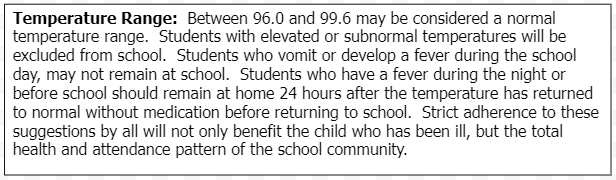
- Children with temperatures higher than 100 degrees should stay home from school. They should not return to school until they have had an unmedicated normal temperature for 24 hours.
- Children prescribed antibiotics for contagious diseases such as strep throat, tonsillitis, bronchitis, or pneumonia should not return to school until they have taken the medication for 24 hours.
- Children who are vomiting or have diarrhea should stay home. The 24-hour rule is a good guideline here, also.
- Parents should make sure “sick days” are not appealing. Staying home sick should mean staying in bed—either sleeping, reading, or playing quietly in bed. Children rewarded with TV, videos, or special treats could quickly learn to prefer home to school. We want children to want to come to school.
Helpful hints for keeping our kids well:
- Washing hands is the single most important thing they can do. A child who hasn’t washed their hands can pass germs along on a pencil or through a group activity.
- Parents and teachers should instruct children to turn their heads and cough into the crook of their elbows. This method reduces the transfer of viruses and bacteria through our hands. Do not cough into your hands. If the child should cough into their hands, please remind them to wash their hands.
- Your child must eat three meals a day,…this includes breakfast. Many students have come to school with a headache and/or stomach ache, most due to a lack of food. Breakfast is the most important meal of the day; please be sure your child is not skipping it.
One more reminder:
- Please keep the phone numbers on your child’s emergency card updated. In the event of an emergency, it is important that we have a current phone number to reach a local parent, relative, or friend. Fax numbers are not acceptable.
MEDICATION AT SCHOOL
Any medication taken by students during the school day must be kept in the health office in their original containers and administered only by authorized office personnel. Medication must be brought to the office with a signed Physician’s Recommendation for Medication form (available in the office), which states the name of the medication, the amount to be given, and the time it is to be administered. The medication remains in the office, and the child must come to the office at the designated time(s) for administration. This includes all prescriptions, inhalers, aspirin, cough syrup, and over-the-counter medications, both oral and topical, etc. Please do not send any medications to school with your child to take on his/her own. This includes:
- Tums or any antacid
- Asprin
These must all be kept in the office for all our students' safety.
NUTRITIONAL GUIDELINES
ARCADIA UNIFIED SCHOOL DISTRICT TK-8 HEALTHY LUNCH GUIDELINES
In an effort to create safer schools for all children, to help students develop an increased awareness of their own responsibility in making healthy nutritional choices, and to meet state and Federal mandates to school districts regarding nutrition, the PTSA and the Arcadia Unified School District have adopted the following guidelines for grades TK through eight.
Rationale: Many students must follow restricted diets for food allergies, religious beliefs, or other reasons. To protect student health, sharing food is not permitted. The district provides a variety of healthy lunch selections each day. The lunch selections served at school must meet specific nutritional guidelines. The guidelines ensure your children receive a healthy and nutritious meal.
Guidelines: For these reasons, the AUSD, PTSA, and administration have committed to working together to promote healthier food choices at school. Whether a child receives a meal at school or brings one from home, the PTSA and AUSD wish to promote a safe and healthy lifestyle.
In support of the desire to promote safe schools and healthy children, the following Healthy School Guidelines and Wellness Policy are adopted:
- Students should develop an increased awareness of their own responsibility in making healthy nutritional choices.
- Students may receive their lunch through the school cafeteria or bring a lunch from home with them in the morning.
- Student lunches should promote healthy choices. Candy, cookies, large bags of chips, and soft drinks do not meet the food guidelines set by the state for The Healthy Meals Act and should not be included in lunches or recess snacks brought from home.
BREAKFAST
At 7:50 a.m., breakfast is available before the start of the school day. Choices include fresh fruit, milk, cold cereal, English muffin, bagel & cream cheese, etc.
LUNCH
Students may bring a lunch from home or receive a free lunch prepared by Nutrition Services.
DUE TO SAFETY CONCERNS
- Parents are not to bring lunch to their children during the school day.
- Students may not have lunch delivered to school by outside vendors.
- Students may not share any food items with other students, as there may be food allergies, dietary restrictions, or other reasons students do not eat certain foods.
- Students may not provide food to other students for the reasons stated above.
No child will be allowed to go hungry. If a child forgets their lunch, they shall be provided with a lunch by the school.
Please be aware, providing special lunches for groups of students is not an appropriate school activity.
PARTIES
The Arcadia Unified School District policy permits two-room parties each year. These party occasions are chosen based on the education partner's input. Your cooperation is appreciated in adhering to this policy because when one room has an additional party, through the thoughtfulness of a parent/guardian, other classes feel disappointed their class is not doing the same. The same applies if parents recognize their child’s birthday by sending gifts, special lunches, or “goodies” to school. We will be unable to distribute these items to the classroom. (Party invitations, which are addressed to less than the total class membership, may not be distributed at school.)
STUDENT PROGRESS: CULTIVATING LEADERS AND LEARNERS
ASSESSMENTS
Students are assessed throughout the school year to determine their growth toward grade-level standards and personal growth, and to identify the next steps needed to achieve continued progress. In grades 3 through 5, students complete the state assessment in English Language Arts and Mathematics. Additionally, fifth-grade students complete the physical fitness test and science test. Kindergarten through fifth-grade students requiring English development as a second language will also be assessed annually in the English Language Proficiency Assessment for California (ELPAC) to review their growth and determine possible evaluation for reclassification as proficient in the English language.
PARENT-TEACHER CONFERENCES & STRONG SCHOOL AND HOME CONNECTIONS
A strong partnership between school and home is essential in supporting a child’s academic, social, emotional, and behavioral development. Open communication, trust, and collaboration between families and school staff help create the best learning environment for students.
When concerns or challenges arise, problem-solving should begin with those closest to the situation, typically the student and the classroom teacher. Teachers are often best positioned to provide context, clarify misunderstandings, and work collaboratively toward solutions. Families are expected to communicate directly with their child’s teacher regarding any concerns. Contact with the teacher will allow concerns to be addressed in a timely and supportive manner.
If additional support is needed, parents may request a conference with the teacher at any time during the school year by contacting the school office or by emailing, calling, or writing to the teacher. School staff and families work together in partnership to support student growth, reflection, accountability, and success.
To leave an email for your child’s teacher, check the school website to verify the email address, School Info/Contact Us. Click here.
STUDENT-LED CONFERENCE
Student-led conferences allow students to demonstrate their academic ability, set goals, and celebrate their achievements and growth. They are led by the student using self-assessment techniques, a portfolio of their work, and student performance.
REPORT CARD
Three times a year, a report card is updated to reflect your child's growth and the areas of development needed. Click here to learn how to access your child’s report card.
SCHOOL/HOME COMMUNICATION
Various communications are created so the school and community can collaborate and work together. Classroom newsletters, Principal’s Newsletter, Konstella and PTA Caminotes provide talking points and events for parents and student involvement. It is highly recommended to check your email frequently for such communications.
SUPPORT SERVICES
ELEMENTARY COUNSELING
The elementary counselor actively assists teachers, parents, administrators, and other staff members in helping students have the best school year possible. The elementary counseling program addresses both preventive lessons and crisis intervention.
ENGLISH LANGUAGE DEVELOPMENT (ELD)
The ELD program is designed to provide additional support for students who are learning the English language as multilingual learners.
SPEECH AND LANGUAGE
The Speech and Language Specialist assists students in K-5 who have been identified with special needs in this area. Support is also provided to parents and teachers on ways to help the student in the classroom and at home.
READING INTERVENTION
The Reading Intervention program provides additional support to core literacy instruction, targeting the development and growth of specific reading skills.
SCHOOL PSYCHOLOGIST
The school psychologist supports families and teachers to create the best possible learning conditions for the whole child; socially, emotionally, behaviorally, and academically.
PARENT AND SCHOOL PARTNERSHIP
PTA
Every adult is encouraged to join the PTA (Parent Teacher Association). PTA membership information will be available at Roadrunner Day. There are numerous opportunities for parents to become involved in their child's school and education. (Examples: Book Fair, Carnival, Room Parents, Red Ribbon Week, etc.) PTA meetings are held monthly in the multi-purpose room or online in a virtual setting. Click here for more information.
PARENT VOLUNTEERS
Parents are encouraged to participate in their child’s education by volunteering in one or more of the following areas: as Library Media Center Aide, at various special events, and as a classroom volunteer. These activities, which depend on parent volunteers, enhance the educational programs that Camino Grove provides our children. REMINDER: Every parent who interacts with the children on the Camino Grove campus must have a current TB Clearance and Volunteer Application form on file. TB Clearance forms are good for four years. Contact the school health office to see when yours expires.- Field Trips are a fun experience for our students to learn not only about real-world experiences but also about being safe, responsible, and respectful while away from home and school. Parent volunteers are selected by the classroom teacher to support the learning experience. Please be mindful that not all parents can attend. Parents will notify the teacher they are interested in supporting the field trip. Teachers then randomly select parent volunteers.
- When volunteering on campus, all student information is confidential. Discussions between students outside the classroom or school setting, such as with other parents, can cause miscommunication and confusion regarding the school’s processes. Confidentiality includes using names, pictures, & specific details of students. If a parent has questions about a student, please direct them to the student’s teacher.
SCHOOL SITE COUNCIL
The council administers School Site Plans that address our students' educational needs and goals. The members of SSC are elected to a two-year term and meet monthly to ensure that the school’s objectives and program needs are met. If you would like more information on how to serve on SSC, please contact the school office.
UNIFORM POLICY GUIDELINES
UNIFORM POLICY GUIDELINES
Students are expected to wear uniforms daily unless circumstances beyond their control prevent them from doing so. A note from the parent/guardian explaining the circumstances is expected that same day. If a student is not in uniform and does not have a note or an exemption, the parent will be contacted by phone or written notice.
Students are excused from wearing uniforms in the following instances:
GENERAL GUIDELINES
All students will come to school in clothing that allows the student to participate in all school activities. All coats, sweaters, and sweatshirts must be labeled with first and last names. Students may not wear clothing or accessories that are gang-related, obscene, suggestive, or promote drugs, alcohol, or tobacco. Make-up may not be worn or brought to school. Every Friday is uniform optional /spirit day.
Pants/Shorts
Color: Blue Khaki (tan), or Black
Style: Fitted at waist or elastic waist (no baggy styles)
Must be size-appropriate
Fabric: Twill, cotton, corduroy, polyester, jeans /denim)
Shirts
Color: White, Blue, Red
Style: Polo, Oxford, Camino Grove spirit t-shirt, or turtleneck
Note: The PTA sells Camino Grove t-shirts and sweatshirts year-round. These items are considered part of the uniform and may be worn at any time.
Skirts/Jumpers
Color: Blue, khaki (tan), or black
Note: Skorts or shorts are acceptable (no short shorts)
Inseam must be fingertip length.
Shoes
Athletic or appropriate shoes (closed heel and toe)
No Crocs or cleats or skate shoes (Socks must be worn)
Sweaters/Sweatshirts
Color: White, Blue, Red
Style: Cardigan, crew neck, V-neck, or zippered sweaters or sweatshirts.
Jackets/Coats
Note: Any jacket or coat may be worn. Must follow general rules.
Hats
Hats must have a brim that covers the neck. No baseball caps will be allowed, other than the Camino Grove spirit baseball hat. All headgear must be removed while in the classroom.
****Please label ALL hats, jackets, sweatshirts, and sweaters with your child's name. ****
Consequences for violation of these uniform standards include, but are not limited to:
- A written notice or phone call to parents/guardians
- A change of clothing/temporary confiscation
UNIFORM OPTIONAL/SPIRIT DAY AND STUDENT EXEMPTION STANDARDS
Our goal is to provide a school climate with minimal disruption to the learning process while maintaining a safe, secure, and enjoyable environment for all of our students. The presence of certain types of clothing and attire can cause substantial disruption of, or material interference with, instructional activities and other school events. The following regulations are in effect for the school year during spirit/uniform optional days or for students who have an approved exemption from the uniform program:
- Hats must have a brim that covers the neck. No baseball caps will be allowed. All head gear must be removed while in the classroom.
- Sagging/baggy pants and/or shorts, hanging or oversized belts and chains attached to clothing or wallets are inappropriate and not allowed. Pants/shorts must be worn at the waist (no more than one size larger than the actual waist size) and stay up without a belt, rope, or suspenders. Pants are not to drag on the ground.
- All clothing should be clean and in good condition. Students should use good taste in all aspects of grooming. Shoes must be in good condition. Bare feet, flip flops, and sandals (open toe/heel) are prohibited. All footwear must fit snugly to the foot, and shoelaces must be tied—no cleats or skate shoes.
- Clothing or jewelry bearing inappropriate advertising and lettering cannot be worn at school. Specifically, T-shirts, hats, or other apparel representing drugs, tobacco, alcohol, sex, gangs, violence, etc., in word or pictures may not be worn. Leave valued items at home.
- Beachwear, sheer or revealing garments, torn clothing, and clothing with holes are inappropriate school attire. Halter tops, backless tops, revealing crop tops, spaghetti straps, and short shorts are inappropriate. The inseam for shorts or skorts must be at fingertip length.
Any top, which does not cover the midriff, is inappropriate.
- A student’s appearance may not detract from nor interfere with the learning atmosphere or process. Any clothing which has a disruptive influence is inappropriate. The discretion of the school administrator will prevail.
Consequences for multiple violations of these standards include, but are not limited to:
-
- A written notice or phone call to parents/guardians
- A change of clothing/temporary confiscation
- Revocation of exemption
UNIFORM OPTIONAL/SPIRIT DAY AND STUDENT EXEMPTION STANDARDS
Our goal is to provide a school climate with minimal disruption to the learning process while maintaining a safe, secure, and enjoyable environment for all of our students. The presence of certain types of clothing and attire can cause substantial disruption of, or material interference with, instructional activities and other school events. The following regulations are in effect for the school year during spirit/uniform optional days or for students who have an approved exemption from the uniform program:
- Hats must have a brim that covers the neck. No baseball caps will be allowed. All headgear must be removed while in the classroom.
- Sagging/baggy pants and/or shorts, hanging or oversized belts and chains attached to clothing or wallets are inappropriate and not allowed. Pants/shorts must be worn at the waist (no more than one size larger than the actual waist size) and stay up without a belt, rope, or suspenders. Pants are not to drag on the ground.
- All clothing should be in clean and good condition. Students should use good taste in all aspects of grooming. Shoes must be in good condition. Bare feet, flip flops, and sandals (open toe/heel) are prohibited. All footwear must fit snugly to the foot, and shoelaces must be tied—no cleats or skate shoes.
- Clothing or jewelry bearing inappropriate or undesirable advertising, lettering, or symbols cannot be worn at school. Specifically, T-shirts, hats, or other apparel representing drugs, tobacco, alcohol, sex, gangs, violence, etc., in word or pictures may not be worn. Leave expensive items at home.
- Beachwear, sheer or revealing garments, torn clothing, and clothing with holes are inappropriate school attire. Halter tops, backless tops, revealing crop tops, spaghetti straps, and short shorts are inappropriate. The inseam for shorts or skorts must be at least 3 inches. Any top, which does not cover the midriff, is inappropriate.
- A student’s appearance may not detract from nor interfere with the learning atmosphere or process. Any clothing which has a disruptive influence is inappropriate. The discretion of the school administrator will prevail.
Consequences for violation of these standards include, but are not limited to:
- A written notice or phone call to parents/guardians
- A change of clothing/temporary confiscation
- Revocation of exemption
CAMPUS ACCESS
During the regular school day, once the final tardy bell rings each morning, the school gates will be locked and the only access to campus will be through the school office.
All visitors and volunteers to the campus must check in at the office first. You must sign in and be issued a visitor badge while on campus. Please sign out when you are ready to leave. This is for the safety of your children and visitors in an emergency. Please note, prior to working on campus or assisting in any and all school activities including, but not limited to field trips, classroom visitations and parties, book fairs, and grade level theme days, all volunteers must have completed the volunteer registration form and have a current TB clearance form on file in our health office. Children, who are not Camino Grove students, may not accompany parent volunteers or visit campus during school hours.
ARCADIA UNIFIED SCHOOL DISTRICT PARENT/GUARDIAN VISITS TO CLASSROOMS
The Governing Board encourages parents/guardians and interested members of the community to visit the schools and view the educational program, open house activities and other special events (BP 1250).
Visitors are expected to:
- Follow the established school policy in requesting a classroom visitation Contact the school site principal or designee via a written request for a classroom visit or as otherwise required by the established school policy
- Complete a visitor‘s permit upon arrival at the site
- Enter and leave the classroom as quietly as possible. Parents will not converse with any students, teachers, and/or instructional aides during the visitation unless invited to by the classroom teacher.
- Do not interfere with any school activity.
- Keep the length (30-minute standard unless otherwise mutually agreed-upon)
- and frequency (no more than 1 time per month, unless mutually agreed upon) of classroom visits reasonable, as established by the principal or designee
- Follow the school‘s established procedures for meeting with the teacher and/or principal after the visit, if needed
- Learn and follow the school-wide behavioral expectations
- Return the visitor‘s permit to the point of origin before leaving the campus.
Relevant Education Code/Board Policy/Administrative Regulations:
○ Parents/guardians may observe instructional and other school activities that involve their child in accordance with Board policy and administrative regulations adopted to ensure the safety of students and staff, prevent undue interference with instruction or harassment of school staff, and provide reasonable accommodation to parents/guardians (Education Code 49091.10).
○ AUSD BP/AR 1250 -- While “To ensure minimum interruption of the instructional program, the Superintendent or designee shall establish procedures which facilitate visits during regular school days. Visits during school hours should be first arranged with the teacher and principal or designee. If a conference is desired, an appointment should be set with the teacher during non-instructional time. To ensure the safety of students and staff and avoid potential disruptions, the Board requires that all visitors and outsiders register with the principal or designee upon entering school grounds.”
○ Upon written request by a parent/guardian, the Superintendent or designee shall arrange for parental observation of a class or activity in a reasonable time frame and in accordance with Board policy and administrative regulations (Education Code 49091.10).
○ AUSD BP 1313 requires "...consistent and appropriate communication and interaction between all parties.... The Board requires positive
communication among all staff and parents/guardians and prohibits volatile, hostile, or aggressive words or actions that could negatively impact the learning environment."
○ Engage in disruptive actions, activities or communication (EC 32210, 32211,
44810, 44811; BP 1313, BP 3515.2).
○ Speak or interact with any student (including their own), teacher, or instructional aide (EC 44810; BP 1250).
○ Conference with the teacher (EC 44811; BP 1250).
○ Electronically listen or record the teacher or students (EC 51512).
BEING ROADRUNNER READY: STUDENT EXPECTATIONS
Student Rights
Every student at Camino Grove has the right to:
- Be treated with kindness, dignity, and respect.
- Feel safe emotionally and physically at school.
- Learn in a positive and supportive environment.
- Express thoughts, ideas, and feelings appropriately.
- Be heard and participate in problem-solving conversations.
- Receive support when mistakes or challenges occur.
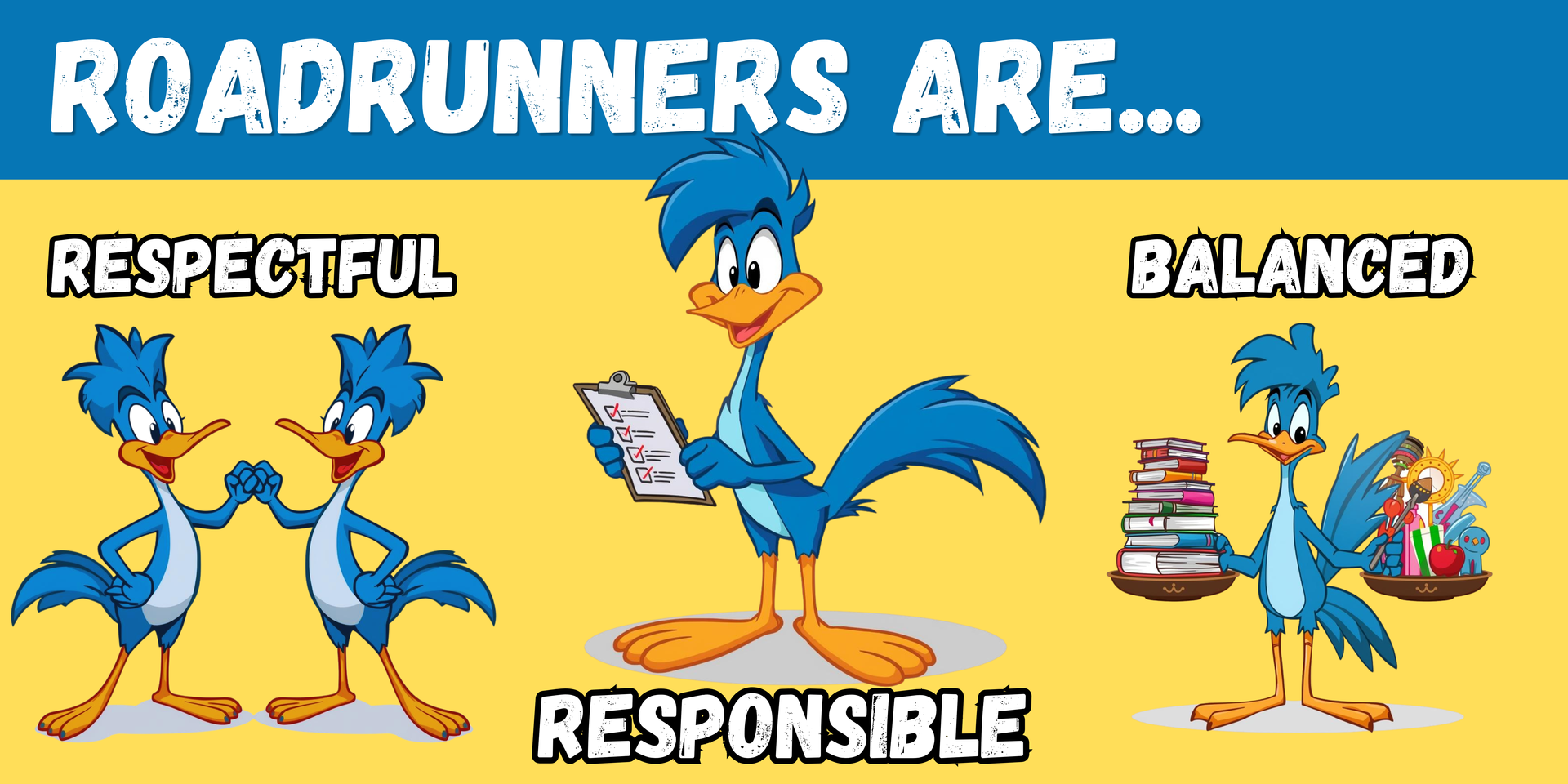
Roadrunners Are Responsible
Responsible students take ownership of their learning, choices, belongings, and actions.
Learning & School Responsibilities
- Arrive at school and class on time by 8:25 a.m., prepared to learn.
- Be seated and ready to work when instruction begins.
- Complete assignments to the best of their ability.
- Follow classroom and school-wide expectations.
Personal & Campus Responsibility
- Take care of learning resources, school property, and shared spaces.
- Stay in assigned areas and follow staff supervision expectations.
- Arrival/Dismissal: Arrive at school no earlier than 7:50 a.m. (as supervision is not available before this time) and go directly home after school unless participating in a supervised activity.
- Report unsafe situations, inappropriate content, or concerns to an adult immediately.
- Accept feedback, reflect on choices, and work toward positive solutions.
Personal Items
To support student responsibility and minimize classroom distractions:
- Leave Non-School Items at Home: To prevent distractions, conflicts, and lost or damaged belongings, all personal items, toys, collectibles, and recreational equipment unrelated to classroom learning must stay home unless a teacher gives explicit permission.
- Forgotten Items: To minimize classroom interruptions and to cultivate responsibility, the front office generally cannot accept forgotten items dropped off during the day (including homework, water bottles, instruments, projects, or jackets).
Roadrunners Are Respectful
Respectful students value themselves, others, and the learning environment.
Respect for Others
- Speak kindly and respectfully to peers and adults using appropriate language, gestures, and tone.
- Respect personal space, boundaries, and listen when others are speaking.
- Allow others to learn without disruption and show good sportsmanship during activities.
Respect for Learning Environments
- Follow behavioral expectations in the classroom, playground, cafeteria, restrooms, and assemblies.
- Eat politely during lunch, clean up your area, and remain seated until dismissed.
- Show appreciation to speakers and performers appropriately during assemblies and events.
Respectful Problem-Solving
- Use words to solve conflicts peacefully.
- Participate honestly in restorative conversations and reflection opportunities.
- Understand that your words and actions have an impact on others.
Roadrunners Are Balanced
Balanced students make safe, healthy, and thoughtful choices that support learning and relationships.
Safe & Healthy Choices
- Keep hands, feet, and objects to themselves.
- Run and play only in designated areas and follow playground safety rules.
- Walk bicycles and scooters on and off campus, and always wear a helmet when riding to school.
- Enter classrooms only when supervised by a staff member.
- Snacks & Allergies: Bring healthy foods as snacks. Energy drinks, sodas, candy, cookies, and large bags of chips are considered "extras" rather than snacks. Food sharing is not allowed due to student food allergies and to prevent misunderstandings.
- A free breakfast and lunch that adhere to the District’s nutritional guidelines are offered before school and during the student’s lunchtime
Responsible Technology Use
Each student receives access to a Chromebook and digital learning tools to support instruction, creativity, research, and collaboration. Access is a privilege that comes with the following expectations:
- Educational Purpose: Use school technology and networks for educational purposes only, following all teacher directions.
- Digital Citizenship: Respect digital learning spaces and the work of others. Cite sources appropriately when using online information.
- Safety & Privacy: Avoid inappropriate searches, messages, or online behavior. Never photograph, video record, or audio record others without explicit permission.
- Reporting: Immediately report any device damage, technical concerns, or inappropriate content to a staff member.
RESTORATIVE AND PROGRESSIVE SUPPORT
At Camino Grove, we believe behavior is an opportunity for learning, reflection, growth, and relationship-building. Our approach to student support is rooted in restorative practices and progressive discipline, helping students develop the skills needed to be responsible, respectful, and balanced community members.
Progressive Discipline
Progressive discipline is a proactive approach used to support, teach, monitor, and strengthen positive student behavior. The purpose is not simply to assign consequences, but to help students gain access to corrective measures and to understand accountability, responsibility, reflection, and the impact of their choices on others.
We recognize that every student and situation is unique. Students may require different levels of support, guidance, reteaching, and intervention depending on their individual needs and circumstances. Addressing challenging behavior is an incremental process that focuses on helping students learn replacement behaviors and restore positive relationships within the school community.
Many behaviors are first addressed by the classroom teacher through:
- Reteaching expectations
- Reflection opportunities
- Problem-solving conversations
- Restorative practices
- Coaching and redirection
- Reinforcement of expected behaviors
Problem-Solving Through Restorative Conversations
Restorative conversations involve students directly in the problem-solving process. This approach supports our commitment to cultivating confident leaders and learners who understand how their actions affect others and how to contribute positively to the community.
Through restorative conversations, students are supported in:
- Reflecting on their choices and actions
- Understanding the impact of their behavior on others
- Listening to multiple perspectives
- Identifying ways to repair harm
- Developing solutions and next steps
- Rebuilding trust and relationships
- Taking accountability for “being better” moving forward
Behavior growth is most effective when supported through a collaborative partnership between the teacher, student, and family. Communication, consistency, and reflection are important parts of the process.

Continued Support & Interventions
If behaviors continue or require additional support, interventions may include:
- Loss of privileges
- Structured reflection opportunities
- Increased check-ins and monitoring
- Counseling or behavioral support
- Parent conferences
- Individual behavior support plans
When additional interventions are needed, the principal, teacher(s), student, and family may collaboratively develop a support plan that includes:
- A specific behavioral or social-emotional goal
- Action steps and strategies
- Progress monitoring processes
- Ongoing communication and support
Reflection, Review, & Confidentiality
When situations arise, school staff take time to understand what occurred by listening to students, gathering perspectives, and reviewing the situation thoughtfully and fairly. Our goal is to support student growth, maintain safety, and help students learn how to navigate challenges responsibly and respectfully.
Because every situation and student is unique, responses and supports may differ based on individual needs, developmental levels, and circumstances.
To maintain student privacy and confidentiality, information regarding other students involved in a situation will remain confidential between the student, their family, school staff, administration, and appropriate support personnel.
District policy elaborating more on behavior, click here.
Home-School Partnership
A strong partnership between school and home helps students grow socially, emotionally, and academically. Families support Roadrunner Ready behaviors by:
- Reinforcing respectful communication and problem-solving. We solve problems by including those closest to the situation. Communication between teachers and parents is critical.
- Encouraging responsibility and independence
- Supporting healthy technology and eating habits
- Maintaining consistent attendance and routines
- Partnering with school staff when challenges arise
Together, we help students become confident leaders and learners through creativity, kindness, responsibility, and balance.
CHROMEBOOK AND TECHNOLOGY EXPECTATIONS
At all AUSD Elementary Schools, we prioritize focused learning, student safety, social development, and in-person interaction. We also value healthy technology habits and strong family communication. For these reasons, students are strongly discouraged from bringing cell phones, smartwatches, or other personal devices to school. The school and Arcadia Unified School District are not responsible for any lost, stolen, damaged, or missing personal electronic devices brought to school.
Device Requirements:
- Cell phones, smart watches, and other personal devices may not be used during school hours.
- Personal device use anywhere on campus is prohibited during school hours.
Parent Communication:
To support a focused school environment and healthy family habits, parents should not contact their child directly via cell phone, smartwatch, or messaging during the school day. All communication between parents and students during school hours must go through the school office or classroom staff. For emergencies or urgent messages, parents should contact the main office.
Important Reminders:
- Using any device to photograph, video record, or audio record others without permission is prohibited by law.
- Students are expected to follow this policy responsibly as part of developing healthy boundaries with technology at school and at home.
Consequences:
Violation of this policy will result in confiscation and must be picked up by a parent or guardian. Repeated violations may result in a parent conference and disciplinary action.
Liability:
The school and Arcadia Unified School District are not responsible for any lost, stolen, damaged, or missing personal electronic devices brought to school.
COMMUNITY SUPPORT SERVICES
AFTER SCHOOL RECREATION
The Arcadia Recreation Department offers after-school activities from 2:35 p.m. until 4:30 p.m. Mon., Tues., Thurs. and Fri. and 1:45 p.m. until 4:30 p.m. on Wed. with the exception of some rainy days and minimum days. Students who participate in the recreation program must follow standards of behavior that are required during regular school hours. This program usually starts in late August and continues until early June. To participate, students must be registered through the Arcadia Recreation Department. For more information, please call: (626) 574-5113.
ARCADIA EDUCATIONAL FOUNDATION (AEF)
AEF comprises Arcadia parents and community members who want to ensure that Arcadia schools continue to provide the excellent quality of education for the 21st century that has characterized Arcadia student performance in the past. Not only does this benefit our students, but also maintains the hallmark educational program that has contributed to community pride and helps sustain the value of our neighborhoods. Camino Grove's parents represent our school in this organization. We are always looking for community members willing to serve in this capacity. If you would like more information, please visit our school office.
All tax-deductible proceeds directly benefit Arcadia’s students. Most of the money raised by AEF has been used to purchase educational technology such as computers, DVD players and chrome book carts. One way to support the foundation is through the purchase of SCRIP. (See section on page 21.) (If you would like to know more about this organization, contact: Arcadia Educational Foundation, P.O. Box 660174, Arcadia, CA 91066-0174.)
RIGHT AT SCHOOL
In addition to providing supervision before and after school, the goal of Right at School is to present pleasant and enriching experiences, which complement regular classroom activities and enhance each participant's cognitive and social development.
For daycare registration information, please visit www.rightatschool.com
EMERGENCY PLAN
DISASTER PREPAREDNESS POLICY AND CHECKOUT PROCEDURE
Our Emergency Preparedness Plan has been developed to ensure the safety, care, and feeding of your child(ren) in the event of a disaster that leaves you unable to get to school for several days.
IN THE EVENT OF AN EARTHQUAKE OR OTHER DISASTER, PLEASE DO THE FOLLOWING:
- The student pick-up area is on the playground. The parent, or someone listed on the Emergency Card, should come to the Sixth Avenue playground gate.
- Look for the sign indicating “STUDENT REQUEST”. Complete the STUDENT EMERGENCY RELEASE FORM and give it to the staff member.
- Your request form will be taken and verified with the student’s emergency card, and your child(ren) will be located at their classroom assembly area.
- Then proceed to the “STUDENT RELEASE” area, where you will be reunited with your child(ren). You will be asked to sign your child(ren) out.
PLEASE REMEMBER . . . The safety and security of everyone is our goal.
- Sixth Avenue is our emergency vehicle access. Please do not double park, block driveways, park in a red zone, or in front of fire hydrants. Also, be sure not to inhibit traffic flow on Sixth Avenue.
- Please, do not search the campus for your child(ren). We have designated search & rescue teams that will complete this task in the most efficient, predetermined manner.
- Please, do not remove your child(ren) without signing them out at the “student release” gate. This is extremely important as we might send a search team to find your “missing” child(ren), when your child may be safe at home with you. This can unnecessarily endanger the lives of our search team and waste valuable time.
- When you get to school, please be prepared to wait. We must document who takes your child(ren) and where they plan to go.
If you have concerns regarding campus safety, please visit our website, cg.ausd.net . Go to Parents, Click on the “Forms and Downloads” link, and print and complete the “To Report Safety Concerns” form. If you want to view the School Site Safety Plan, a hard copy is available in the front office.